
Bored Piles vs Screw Piles for Site Conditions

A foundation decision made before a detailed ground model is available can set the wrong constraints for the entire construction programme. When assessing bored piles vs screw piles, the relevant question is not which system is generally better. It is which system provides verifiable capacity, acceptable construction impacts and dependable long-term performance for the specific site, structure and delivery strategy.
Both systems transfer structural actions through weaker or variable near-surface soils into competent bearing strata, or develop resistance along the pile shaft. Their installation methods, tolerances, risks and verification requirements are materially different. That difference affects design coordination, approvals, site logistics, cost certainty and asset assurance.
Bored piles vs screw piles: the fundamental difference
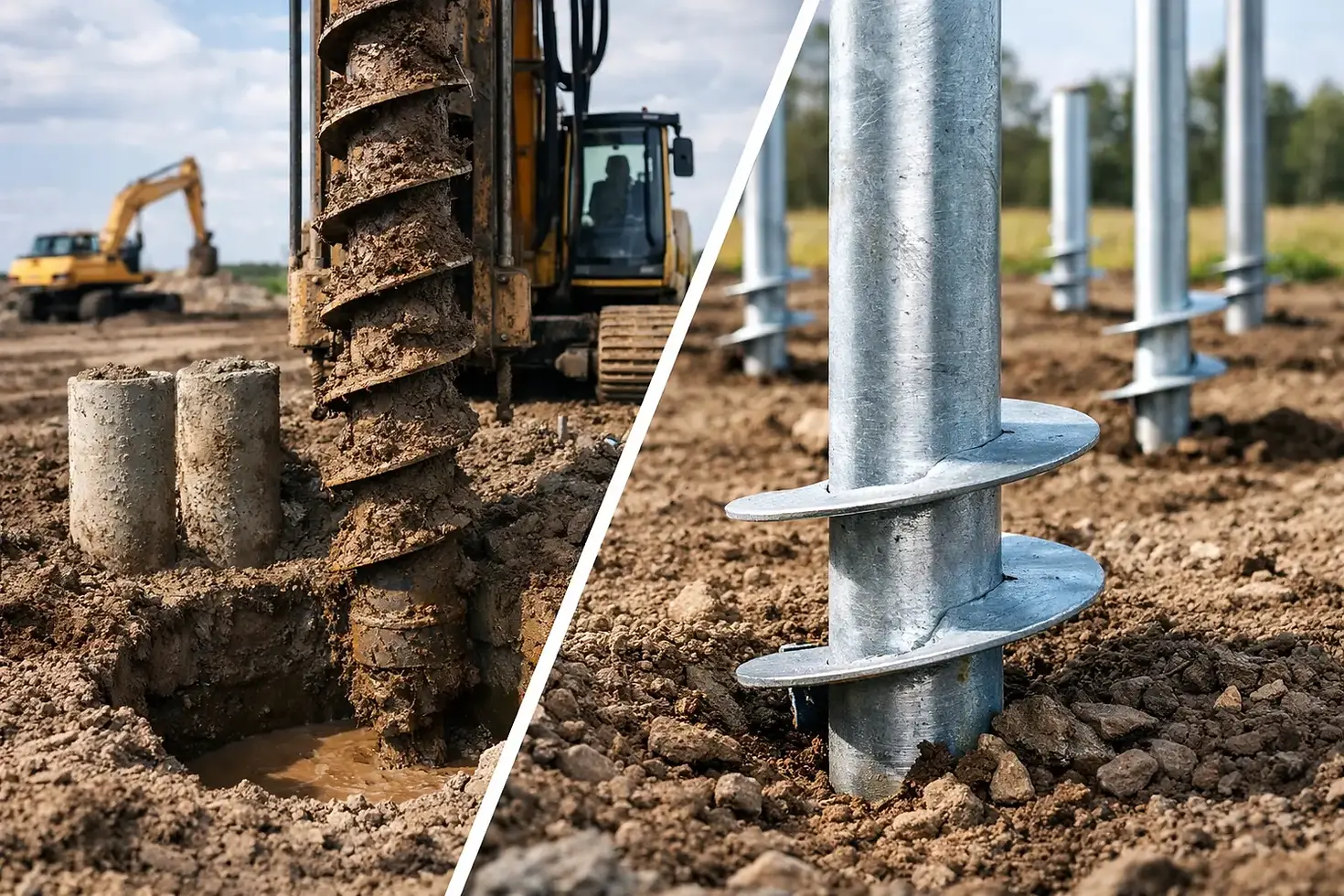
Bored piles are formed by drilling or augering a hole, installing reinforcement where required and placing concrete. Depending on the ground and design, the bore may be unsupported, stabilised with temporary casing, or supported with drilling fluid. Diameters can be tailored to the required axial, lateral and moment capacity, making bored piles a well-established solution for substantial building and infrastructure loads.
Screw piles are installed by applying torque to a steel shaft fitted with one or more helical plates. The helices advance through soil with limited excavation, and the pile is typically connected to the structure through a pile cap, bracket or steel head. Installation torque is a key field indicator, but it must be correlated to the geotechnical model and verified against project-specific acceptance criteria rather than treated as a standalone proof of capacity.
The terminology needs care. In the Australian market, ‘screw pile’ can describe proprietary helical pile systems with different shaft geometries, helix arrangements, corrosion protection and connection details. The engineering assessment must therefore be based on the nominated system, its testing evidence and its installation methodology, not a generic product category.
Ground conditions drive the selection
A high-quality geotechnical investigation is central to selecting either foundation type. Boreholes, CPTs where suitable, laboratory testing, groundwater observations and a clear understanding of site history all contribute to a defensible pile design.
Bored piles can be effective where substantial capacity is needed at depth, where variable fill overlies stronger material, or where a larger diameter shaft is required to resist lateral movement and bending. They can also be adapted when obstructions, rock interfaces or deeper founding levels are encountered, although these conditions may slow production and require specialist drilling methods.
Screw piles are often well suited to sites with relatively consistent soils that allow predictable advancement and torque development. They can be particularly valuable where access is constrained, excavation must be minimised, or rapid installation is important. However, very dense sand, hard residual soils, cobbles, boulders, buried demolition material and rock can prevent advancement, damage helices or produce torque readings that do not represent the assumed installation condition.
Neither system removes the uncertainty created by poorly characterised ground. On urban redevelopment sites, uncontrolled fill, old footings, services and contaminated material can affect both methods differently. Bored piles may expose these issues through spoil and bore logs. Screw piles may encounter refusal before reaching their intended depth. A design that allows for verification, contingency and timely engineering review is more valuable than an early preference for a single method.
Structural demands and serviceability matter
Foundation selection should address more than ultimate vertical compression capacity. The pile system must manage lateral loads, uplift, cyclic effects, settlement, group interaction and the connection between the pile and superstructure.
Bored piles offer flexibility where high column loads, basement retention interfaces, bridge supports or significant lateral actions demand large diameters and reinforcement cages designed for bending. Their stiffness can be advantageous where differential movement must be tightly controlled. For heavily loaded structures, bored piles may also reduce the number of pile locations, although this can be offset by longer installation times and more complex quality controls.
Screw piles can provide efficient compression and uplift resistance, especially where helical geometry can mobilise suitable bearing horizons. They are frequently considered for light to medium structures, temporary works, remediation works, extensions and constrained-access applications. Their smaller shaft sizes can be less favourable where substantial lateral capacity or high bending demand governs, although engineered bracing, pile groups, larger proprietary sections or hybrid solutions may address this.
Settlement predictions require the same discipline regardless of pile type. The design should consider load distribution between piles, founding stratum variability, downdrag where compressible fill or soft layers consolidate, and the performance of pile caps and ground beams. Capacity alone does not establish serviceable foundation behaviour.
Construction impacts, access and programme
The construction method can be the deciding factor on a live site. Bored piling generates spoil, requires concrete supply and creates a need to manage bore stability, groundwater and reinforcement placement. Spoil classification, transport and lawful disposal can become a significant cost and programme issue, particularly on contaminated or space-constrained sites.
Screw piles produce comparatively little spoil and can often be installed using compact equipment. This can reduce truck movements, excavation and disturbance to nearby operations. They are also immediately available for loading once installed and accepted, avoiding concrete curing periods. Those benefits can support programme certainty for suitable projects.
However, faster installation is not automatic. Screw pile productivity can fall sharply when unexpected obstructions or difficult strata are encountered. Bored piles can likewise face delays from collapsing bores, groundwater inflow, hard rock or concrete placement constraints. Productive planning includes trial installations where appropriate, clear hold points, access assessments, service proving and realistic allowance for ground-related variation.
Noise and vibration must also be assessed in the local context. Both systems may be preferable to driven piling near sensitive assets, but drilling rigs and hydraulic installation equipment still generate noise, movement and traffic impacts. Adjacent building condition surveys, utility protection and monitoring requirements should be established before works commence.
Verification and quality assurance
Piling is a concealed work. The project team must be able to demonstrate that the installed foundation corresponds with the design intent and applicable requirements, including AS 2159, project specifications and authority conditions.
For bored piles, quality assurance commonly addresses bore depth and diameter, founding level, bore cleanliness, casing or fluid management, reinforcement cage details, concrete volume, slump and placement records. Where conditions warrant it, integrity testing and load testing can provide further evidence of continuity and performance.
For screw piles, installation records should capture pile type, shaft and helix configuration, depth, inclination, torque progression, extension details and final acceptance values. Test piles and proof testing may be essential where design correlations are being confirmed or ground variability is material. The installer’s equipment calibration and the traceability of pile components should be treated as project controls, not administrative detail.
A practical distinction is that bored piles allow direct inspection of extracted material and recorded bore conditions, while screw piles rely more heavily on installation response and pre-established correlations. Both require competent supervision and prompt communication between the geotechnical engineer, structural engineer, contractor and superintendent when field conditions differ from the assumptions.
Whole-of-life considerations
Durability is not secondary to capacity. Steel screw piles require corrosion assessment based on soil chemistry, groundwater, stray current risk and required design life. Sacrificial steel allowance, coatings, galvanising or other protection measures must suit the exposure environment and connection details.
Reinforced concrete bored piles require consideration of concrete durability, cover, groundwater chemistry and construction defects that could affect long-term performance. In aggressive environments, material specifications and installation controls should be coordinated early rather than resolved after the foundation layout is fixed.
Environmental effects also differ by site. Screw piles can reduce spoil generation and may be removed or reused in some temporary applications. Bored piles may be better suited to long-life, high-capacity assets but can involve more material, waste handling and concrete-related emissions. The appropriate comparison considers the whole project, including transport, programme, remediation risk and design life.
A disciplined decision process
The best choice is usually reached through coordinated geotechnical, structural and construction engineering rather than a product-led comparison. Establish the load cases and movement criteria, develop a ground model appropriate to the risk, review access and environmental constraints, then test the constructability assumptions with specialist contractors.
For projects where the consequences of foundation movement are high, early pile trials or load tests can provide valuable certainty before full-scale installation. This is particularly relevant for complex sites in Sydney and other dense urban environments, where neighbouring assets, restricted access and variable ground conditions can be as influential as the building load itself.
Bored piles and screw piles are both capable foundation systems when selected for the conditions they are designed to address. The useful decision is the one that makes ground behaviour, installation evidence and long-term performance visible before construction commits the project to a path that is difficult to change.


Comments